
The cards entered Europe through the Mediterranean trade networks that Mamluk workshops had themselves built as their domestic patronage contracted. Marseille was the entry point - the port city that had maintained direct commercial relationships with Islamic Egypt for centuries, the one French city whose mercantile infrastructure was built around Levantine trade. The Rhône valley ran north from Marseille through Lyon to Paris. The cards followed it.
And somewhere along that corridor, the back of the cards have changed.
This was not standard French practice. French cards were produced with blank backs well into the modern period. A decorated back on an early French deck is an anomaly - something that requires explanation, not an assumption. The explanation the three surviving decks provide is a story told in three stages, moving north.
Europeans read from left to right. The Islamic world reads from right to left. Place the three decks side by side and the same object tells two different stories depending on where you begin. The European reader starts from Noblet and moves toward Conver - from Paris toward Marseille, from the familiar toward the foreign. The Islamic reader starts from Conver and moves toward Noblet - from the origin toward the destination, watching the grammar dissolve as it goes north. Dodal sits at the center of both readings simultaneously. It is the hinge in both directions.
The names of the makers carry this quietly. Conver - from Latin conversus, the turned one, he who crossed from one world to another. Dodal - from Proto-Indo-European deh₃-, the giver, he who passes forward. Noblet - from Latin nobilis, itself from archaic gnobilis, literally knowables. Noblet is a diminutive. The small knowing at the end of the corridor. The one who received what had been turned, given, and carried north - and did not know what he held.
The Conver deck, made in Marseille, has backs that belong to the same geometric tradition visible on the face. Diamond grid tiling. Radiating centers. Organic forms consistent with the Islamic arabesque vocabulary - the living geometric grammar still intact at the southernmost point of the corridor. The back and the face speak the same language.
The Dodal deck, made in Lyon - the midpoint, the city where the Rhône corridor pauses before the final push to Paris - has a back that carries a pure chevron repeat, a directional triangle field pointing north. It points exactly where the object is going. Lyon is the deck that knows it is in transit, and says so on its reverse. The Two of Deniers carries a commercial identity - the card read as currency, on the deck that is already pointing toward where the flower will be put.
The Noblet deck, made in Paris, has a back that carries a hexagonal Maltese cross. The diamond grid is gone. At the center of the cross there is a circle - and through the circle, an X. A circle with an X through its center is the closed flower in Mamluk decorative vocabulary: the sealed flower, the extinguished geometric core. The geometric origin has been sealed. It does not radiate. What had been a living center in Marseille, a directionless field in Lyon, is in Paris a cross with a wound in the middle of it.
The backs tell the story that the faces tell more slowly. Marseille: the center lives. Lyon: the center is moving. Paris: the center is sealed.
The Noblet deck removed the flower from the Knight of Batons leg - the last living organic element at the hinge point between the living and the mechanical suits. The same cancellation, in the same city, on both sides of the same object. It sealed the flower on the back. It removed it from the front. The moving has been stopped.
The Flower
The Mamluks were slave soldiers. They were purchased as children, trained as warriors, and owned by the state until their military value produced enough political weight to make them the state itself. The body of a Mamluk belonged to his master. His rank belonged to his performance. His identity belonged to his regiment. There was no category of Mamluk life that was not administered.
Against this, one territory remained unowned: the soul.
The Arabic word for soul is rūḥ - the breath, the animating principle, the thing that could not be inventoried. The rūḥ was the one possession that no bill of sale could transfer. The Quran makes this explicit and makes it inexplicable simultaneously: when asked about the spirit, the answer given is that it belongs to the command of God, and that human knowledge of it amounts to very little. The rūḥ is precisely the thing that exceeds the ledger.
The Mamluks played cards. They produced, from the same workshops that illuminated Quranic manuscripts, a deck whose suit structure encoded the binary mathematics of their theological tradition. The soft suits carried the living world - Cups and Deniers, spirit and matter, the organic and the circular. The hard suits carried the defended world - batons and swords, the tool and the blade. Everything in the deck breathes or cuts. Above all of it, twenty-one trump cards - exactly the number of times the word rūḥ appears as a noun in the Quran. The animating principle. The layer that overrides everything beneath it. The thing that cannot be fully explained and simply overrides.
At the center of the sword suit they placed a flower.
The flower is the Denier. The radiating organic form that is the suit of Deniers before it becomes a Denier - the living center that the Islamic geometric tradition places at the origin of every construction, the point from which all arcs are drawn, the seed before it hardens into currency. In the sword cards, the curved scimitars do not attack. They cross around the flower. They form a protective lattice with the flower at the center. The even-numbered cards hold this formation. The odd-numbered cards show the moment of breach, a blade forcing through. The flower at the center of the Sword cards is not decorating the cards. It is what the scimitars are fighting over.
The scimitars are not fighting Europe. They are carrying something north.
What the Mamluks sent was more than a game. It was the record of what a soldier who owns nothing keeps at the center of his formation when he has no choice but to move through hostile territory. The body goes where it is ordered. The flower travels inside the blades. The back of the deck is blank because the flower does not announce itself. It simply goes.
What the West Received
Europeans received the cards and looked at the center of the Denier formation and saw money.
The suit of Deniers - the Denier - is the flower suit read by people who understand flowers as currency. The flower, the radiating circle, the geometric construction that the Islamic tradition places at the origin of every formal system: in European hands, it went into a wallet. The irony is exact. Mamluk coins carried no flowers inside enclosed circle. They carried writing - the words pressed into metal. It was on the card. Europeans looked at the card, saw a circle, and assumed they understood what a circle from that world meant. The engravers put their commercial identity on the card they understood as valuable. They signed the Denier. The Two of Cups - the spirit card, the card Michael Dummett identified as carrying design elements that must descend from a period when Islamic cards were still living objects.
This is not a failure of intelligence. It is a failure of vocabulary. The Europeans who received the Mamluk cards received the forms without the language those forms were encoded in. They could see the crossing blades. They could see the flower at the center. They reproduced both across generations of printing without being able to read what the arrangement said. The form felt significant enough to preserve. The significance itself had been left behind in the East.
The quality differential in the surviving decks records this failure precisely. Denis Diderot, writing in the eighteenth century, found it surprising how poorly the court cards were drawn given the generally good taste of the French in visual matters. He had no explanation. The explanation is that the geometric skeleton of the deck - the pip arrangements, the compositional armature, the precise crossing formations - was received from geometric templates. The faces were approximated by French makers working from no equivalent discipline. The geometry holds because it was cut from a system. The faces drift because they were cut from memory. The Islamic craftsmen drew what they would draw, and faces were not among them - not from incompetence, but from a precise theological boundary: the prohibition targets the depiction of that which possesses a soul, and the locus of the soul is the face. The craftsman who will not draw a face is not failing. He is being exact about where the boundary lies.
So the flower became decoration. Lucky symbol. Ornament on cards carried by people who had no particular relationship to Mamluk theological geometry. The object that had been a record of the one territory a slave soldier could call his own became a charm for fortune - appropriate, in its way, for people who also had nothing to offer but their luck and their soul, since their bodies belonged to their labor and their labor belonged to someone else.
The Denier absorbed the flower. The flower became the Denier. The wallet held what the scimitars had carried.
Major Cards
The Noblet deck makes this boundary visible in a specific way that the Conver deck does not. The Noblet Fool has exposed genitals - rendered with more apparent precision than the face above them. The Noblet Bateleur carries what appears to be a deliberate phallic gesture, again more carefully executed than his other hand. These are not accidents or crudeness. A craftsman who cannot produce a competent human face has nonetheless produced, with deliberateness, genitalia. Genitalia do not imply a soul. They are bodily, anonymous, generic. In the terms of the Islamic theological prohibition, rendering them is impious but not in the specific way that rendering a face is impious. The Conver deck, closer to the origin, carries neither. What entered Paris that was not present in Marseille is the vulgarity - the precise expression of the one figural territory that the theological boundary left open. The faces remained unpracticeable. Everything below them was not.
The unnumbered major card, the one who stands outside the sequence - carries this gradient in full when read left to right across the three decks. In the Noblet, he is vulgar: the body debased, the animal at his feet a footnote to a figure already reduced. In the Dodal, he is alive - the most alive of the three. The animal is fully present, warm, the whole figure breathing with an energy that belongs to the living world. In the Conver, he is almost free of it. The animal is still there but the figure has begun to pull away, to compose itself, to move toward something cleaner. Left to right: vulgarity, life, purification. The arc runs from Paris toward Marseille, from the debased toward the source, and the source is approaching something that the fourth position - the blank card, the one not yet made - would complete.
Card I - faces West. He performs. He tricks. He is the first numbered trump and he is already turned toward Europe, toward the audience, toward the market. Everything he does is for the person watching. He is the beginning of the sequence and he has already forgotten where the sequence came from.
The unnamed Major card follows through 3 type of decks, before ending his way to the purification.
The Sword that Destroys, Yet Enriches
But Europe did not only receive the flower. It received the sword formation - and then it put its own blade inside it.
The scimitars in the Mamluk deck did not originate in Egypt. They came from the steppe. The Mamluks were recruited as children from the Kipchak Turkic peoples of Central Asia - cavalry soldiers whose curved blade was the instrument of a riding culture, a blade designed for the slash from horseback, for speed across open ground. When the Mamluks were purchased and trained and sent to hold Egypt against the Mongols, they brought that blade with them. At Ain Jalut, where the Mamluk cavalry stopped the Mongol advance, it was the curved blade of the Kipchak steppe that held the line.
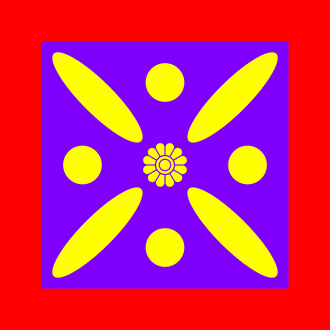
Behind the blade, further back along the same thread, stands the Derafsh Kaviani - the royal standard of the Sassanid empire, the banner whose capture at the Battle of al-Qadisiyyah meant the capture of Persia's fate. Its central emblem was the akhtar, a star, a radiating form, a flower by another name. The decorative grammar that traveled from that banner through the Sogdian merchants of the Silk Road, through the Persianate court culture the Mamluks inherited, through the workshop traditions that illuminated Quranic manuscripts and produced playing cards - that grammar is still carried in Tajikistan. The Tajiks count the Sogdians among their principal ancestors. The Derafsh Kaviani lives in their culture. The flower at the center of the Mamluk sword cards and the flower at the center of the Tajik flag are downstream of the same river. The cards are one of the places that river surfaced in the West.
This is what the scimitars were carrying. Not just the flower of the pip suit. The entire visual memory of a civilizational tradition that had been encoding the radiating center - the unownable soul of a culture - in banners, metalwork, manuscripts, and now cards, for a thousand years before the deck reached Marseille.
In the Topkapi deck - the surviving Mamluk cards held in Istanbul - there are no straight swords. Every blade is curved. The crossing arrangement, the protective formation around the center - all of it is curved, all of it is one tradition speaking in its own grammar, carrying its own memory of what the blade meant and where it came from.
The straight sword appeared later. It appeared in Europe.
In the Tarot de Marseille, the odd-numbered sword cards show a single fully-rendered straight sword standing vertical at the center of the crossing curved blades. The mandorla of scimitars is intact. The memory of the steppe is intact in every curved line. And inside it, standing at the exact position where the flower stands on even-numbered cards, is a European blade.
Nobody planned this. The European craftsmen who reproduced the Mamluk arrangement were copying a form they had inherited, simplifying where they could, preserving the structural relationships that felt load-bearing. The straight sword entered the formation the way a language enters a sentence it was not written for - by finding the slot that was already open and occupying it.
The result is a picture. On even-numbered cards: curved scimitars crossed in a protective formation, flower at the center. On odd-numbered cards: the same formation, same scimitars, same crossing - and a straight European blade where the flower was.
The alternation is the argument. The cards do not show conquest. They show replacement. Card by card, through the even and odd numbers, the object carries both versions of what was at the center of the formation: what the Mamluks placed there, and what Europe put there instead. The flower and the blade, alternating, in the same protected position, through the entire suit.
The geographic gradient makes this replacement visible at a larger scale. The Conver deck, made in Marseille, carries the most intact Islamic formal grammar. The angel on the Lovers card has eyes. It sees. The Emperor carries a circular amulet at his neck - what the Sufi tradition calls the ayn al-qalb, the eye of the heart, the faculty through which the heart perceives divine reality directly. The Page of Batons still has a flower on his leg.
The Dodal deck, made in Lyon, is caught at the hinge. The Emperor is between the eye and the scepter, between spiritual perception and institutional power. The deck points in both directions simultaneously and commits to neither. Lyon is the city that remembers where it came from and knows where it is going without yet having arrived.
There is one further detail about the Emperor that the deck carries in plain sight. Card IV sits with his legs crossed - and the crossed legs form the shape of the Arabic numeral 4, the same number as his position in the sequence. The number is written in his own body. Inside the court cards only King of Deniers inherits this structure. Because it mattered. But also with a straw from that sucked up his mind in Dodal.
The Noblet deck, made in Paris, has replaced all of it. The angel on the Lovers card is blindfolded. Blindness is the attribute of Fortune, of chance, of a force that operates without knowledge - and the Islamic theological tradition has no such force. Divine agency does not operate blindly. The rūḥ descends by command. Command requires vision. The blindfold converts the angel of divine command into Cupid. It converts theology into chance. In Marseille the wing belongs to a messenger acting under command. In Paris the wing belongs to a child shooting blindly.
The Emperor in Paris stares at his scepter. The eye is gone. He contemplates his own power. Nothing outside himself. The Pope leads to Cupid in Paris. The Pope leads to a seeing angel in Marseille. Two different answers, in the same positional sequence, to the question of what divine authority produces in the world after it passes through human institutional form.
The object moved from Marseille to Paris and was progressively emptied. What arrived in Paris was the shell. The back of the Noblet deck carries the proof: a circle with an X through it, where the radiating center used to be.
The game preserved what the game did not know it was preserving. Including the record of its own emptying.
Who Carried the Cards
The Mamluks were soldiers whose bodies were owned. They built an institution, encoded their theology in a game, and sent it north inside a commercial network they had built to survive the collapse of their domestic patronage. The flower traveled inside the blades because that was the only way it could travel. The back of the deck was blank because the flower does not need an announcement. It simply moves.
In Europe, the cards moved through the populations that the European social order had least use for - itinerant workers, travelers, the marginal, the poor, the people whose labor was purchased seasonally and whose persons were of no lasting account to anyone. Fortune-tellers. Wanderers. People for whom the Wheel of Fortune was not an allegory but a description.
These were also people whose bodies were not entirely their own. Not enslaved - the European categories are different - but also not free in any sense that made the distinction feel absolute from the inside. The cards found them. Or they found the cards. Either way, the object that had been designed by slave soldiers to carry the record of an unownable soul ended up in the hands of people who needed exactly that record and did not know where it came from.
The flower became a luck charm. The rūḥ became fortune. The unownable soul became the hope of the dispossessed. The translation is imperfect. The transmission is exact.
What the Mamluks put at the center of the crossed blades was the one thing the ledger could not hold. What the European poor found at the center of the same formation - reduced, simplified, half-legible - was the same intuition in a different language. That the body could be bought and the soul could not. That something at the center of the formation was worth protecting. That the blades existed to carry the flower, not to bury it.
The engravers signed the Denier. They left the soul unsigned. The soul outlasted the signature.
The Denier absorbed the flower. The wallet held the record. But the people who carried the cards kept turning them over - face to back, back to face - looking at the crossing blades on one side and the sealed X on the other, feeling the charge of the arrangement without being able to read the language it was written in.
The structure remained.
There are many more details than this text shows, and I will be adding them over time - this is a living document. Anyone who wants to look for themselves, or offer observations, can use the comparison tool:
Side-by-side comparison of the Noblet, Dodal, and Conver decks - card by card
No files are uploaded to any server. Everything runs locally in your browser.